
As the fintech sector matures, the focus is shifting from disruption to disciplined scale, as Michael Boel,
Co-Head of Clearing Technology, explains.
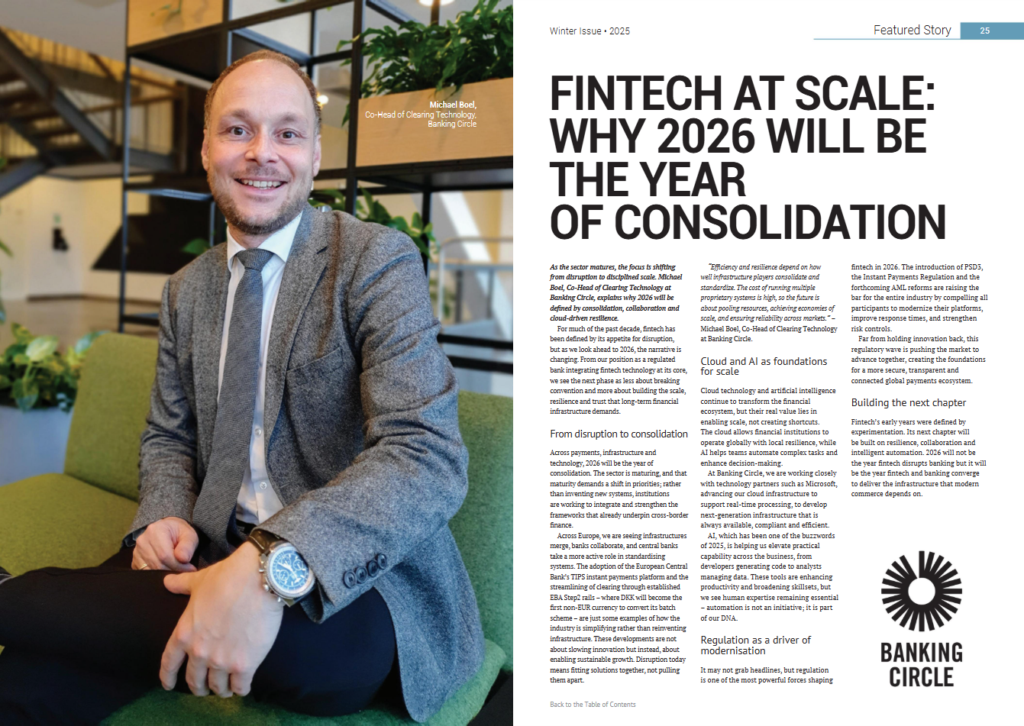
Featured in Financial IT‘s Winter Edition 2025, Page 25. Read the article here: https://lnkd.in/ewMPsq4b.
For much of the past decade, fintech has been defined by its appetite for disruption, but as we look ahead to 2026, the narrative is changing. From our position as a regulated bank built on fintech technology, we see the next phase as being more about building the scale, resilience and trust required of long-term financial infrastructure.
From Disruption to Consolidation
Disruption in financial services has led to a fundamental shift in the nature and delivery of financial services. Gone are the days of incremental innovation and old products delivered through new channels.
A combination of new technologies, customer expectations and regulation has transformed we think about money. Cloud computing, APIs, 5G rollouts, ubiquitous connectivity, distributed ledger technology and so on have allowed us to re-imagine how we interact and transact with financial services.
Disruption in financial services has been about hardware, how to build software and simplifying for a more cost efficient offering. It’s been about how banks, fintechs, central banks and regulators adopt and deploy technology. And how they redesign business models, processes and the industry for longevity.
That’s why I believe that 2026 will be the year of consolidation. The sector is maturing, which demands a shift in priorities. Institutions are working to integrate and strengthen the frameworks that already underpin cross-border finance, rather than invent new systems.
From Un-Bundling to Re-Bundling
Over the past 10-15 years, disruption in payments, lending, brokerage led to an un-bundling of the proposition. Individual functions were split out into specific disciplines or centres of expertise. Now we’re seeing consolidation via a re-bundling and the return to a universal banking proposition.
Of course, the business of banking cannot stand independently from the technology of banking. We’re seeing technology, whether it’s cloud or various ‘as-a-service’ capabilities, inspiring new ways of thinking in the age-old buy, build, partner debate.
Businesses can build their proposition in-house by using plug-and-play functionality. That’s how new players are entering the market. Old players are re-inventing themselves. And players that don’t necessarily have a background in financial services are embedding payments, lending, investments, insurance and more into their offers.
Naturally, businesses can also buy and partner with competitors, peers and so on. We’re seeing payments companies merging with lending companies to create stronger, more appealing offers. And clearly, there are as many different types of partnerships within and between businesses as there are partners.
Building The Next Chapter
Across Europe, we’re also seeing central banks take a more active role in standardising systems. The adoption of the European Central Bank’s TIPS instant payments platform and the streamlining of clearing through established EBA STEP2 rails are two examples of the industry consolidating through the simplification of infrastructure.
The cost of running multiple proprietary systems is high, so the future is about pooling resources, achieving economies of scale and ensuring reliability across markets. That’s a big part of why Denmark is retiring its domestic batch clearing system and moving to the EBA STEP2. DKK will be the first non-EUR currency to be included in this pan-European automated clearing house system.
It’s also why central banking authorities in Denmark and Sweden moved to have DKK and SEK integrated in the TIPS system. The European Central Bank (ECB) is bullish on building out cross-border interoperability for TIPS as it facilitates real-time central bank money settlement. Plans are underway to connect TIPS to the Swiss National Bank system – and potentially with other clearing systems intra- and inter-regionally.
Regulation As a Driver of Modernisation
It may not grab headlines, but regulation is one of the most powerful forces shaping the financial services industry in 2026.
The introduction of a new Payment Services Directive (PSD3), the Instant Payments Regulation(IPR) and the forthcoming anti-money laundering (AML) reforms are casting their shadows forward. They are raising the bar for the industry, compelling all participants to modernise their platforms, improve response times and strengthen risk controls.
However, I would counsel businesses against treating regulatory compliance as a box ticking exercise. In meetings with clients, prospects and central banks, it’s emerged that banks have built systems to meet the minimum requirements. So, they may struggle with real-world instant payment volumes – some can only process as few as six transactions per second before their systems begin to reject transactions.
Banks, fintechs, payment services companies and others would be well advised to go beyond minimum compliance requirements, especially when it comes to capacity. This will ensure that they are technically but also commercially fit for purpose and fit for the future.
From Disruption To Disciplined Scale
Fintech’s early years were defined by disruption and experimentation. Disruption today means fitting solutions together, not pulling them apart, to achieve sustainable growth.
So, its next chapter will be built on resilience, collaboration and intelligent automation. 2026 will be the year when fintech and banking continue to converge, united by the imperative to deliver the infrastructure that modern commerce depends on.
